


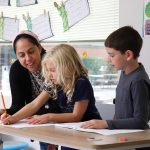


Building literacy skills is of the highest importance in the Lower School grades. Students in kindergarten and first grade read 1:1 each day with a teacher using Fountas & Pinnell leveled reading. As second and third graders transfer from ‘learning to read’ to ‘reading to learn’ they begin daily reading through book clubs in the classroom, exploring the complexities of longer texts and various genres of novels. Components of the Teachers College at Columbia University Reading and Writing Project supplement the curriculum and provide skills and strategies for all Lower School students to use. Students in Kindergarten through Grade 3 select books to bring home nightly to read and further develop literacy skills at home.
The Wilson Phonics Fundations program provides support for our emerging readers through a multisensory approach so that students learn by doing. Phonics knowledge builds a strong foundation which helps children to sound out and eventually write words of increasing complexity.
The Writing Workshop model developed at Teachers College by Lucy Calkins is used to develop young students into proud authors. During Writer’s Workshop, students conference individually with teachers throughout the many steps of the writing process, from prewriting through publication, and enjoy publishing parties to display and share their work! Daily writing lessons begin in kindergarten by writing small moment narratives and then expand throughout the Lower School grades to include informational texts, expository, narrative, opinion, persuasive essays, and creative pieces. Students demonstrate an increasing command of grammar conventions in both writing and speaking and become more familiar with nuances in word meaning and figurative language. The acquisition of vocabulary and mastery of spelling are both explicitly taught and integrated into multiple facets of the day and across the curriculum.
Students transition from print to script writing in second grade using the Handwriting & Cursive Without Tears program. As students begin using Chromebooks in third grade, the curriculum adapts to add Keyboarding Without Tears to teach touch typing.
The Lower School math program develops students’ abilities to become creative and critical thinkers while emphasizing the understanding of mathematics through problem solving strategies, computational skills, and number sense. The Saxon Math program is used in all Lower School grades. This spiral curriculum presents an engaging hands-on lesson each day with follow-up checks for understanding and retention of previously learned topics. In addition to mental math and skill acquisition, open-ended investigations provide students the opportunity to ask questions and seek answers as they search for patterns, explore multiple ways to approach a problem, and apply higher order thinking skills in creative ways.
Mathematics is practiced across the curriculum and differentiated hands-on centers and activities are added to help students develop at their own appropriate pace.
Children are born curious, but it takes the right learning environment to preserve and develop their curiosity. Designed to harness the innate inquisitive nature of young children, the science program is engaging and relevant. Students are active participants as they explore big-idea learning units such as life cycles of plants and animals, classifying organisms, simple machines, states of matter, and motion. By focusing on topics that are of natural interest to children of this age, student questions fuel the direction of instruction, engaging our young scientists and sparking an interest to take their learning even further.
Using the Engineering is Elementary program, students learn to think and speak like budding scientists and engineers. Design thinking takes center stage in these units of studies as students design their own water filters, build bridges, and design hand pollinators. Students are introduced to programming and coding using our Dot and Dash robots.